
If you run a commercial laundry or manage operations in a hotel, care home or similar, you don’t need reminding that the last few years have been challenging. Energy costs have been unpredictable, staffing remains tight, and expectations around sustainability and hygiene are only moving in one direction.
What is changing, though, is how the industry is responding. Judging by recent product launches and industry conversations, efficiency, automation and sustainability have become recurring themes across the commercial laundry sector.
The shift is being driven both by operators and manufacturers, with companies such as Miele Professional clearly positioning themselves around those same priorities.
Efficiency is now the central conversation
For most operators, the biggest pressure remains cost, particularly energy. That hasn’t gone away, and it’s unlikely to in the near term. What’s different is how directly efficiency now translates into competitiveness.
Newer commercial machines are not just marginally better; they’re designed to process more laundry in less time, with lower water levels and reduced energy consumption per cycle. Miele’s latest developments are a good example of this direction. Their newer systems focus heavily on shortening wash cycles and increasing spin efficiency so that drying times, and therefore energy usage, are reduced as well.
That combination matters. Faster throughput isn’t just operationally convenient; it can mean the difference between adding capacity and avoiding additional labour or equipment.
Bigger loads, fewer bottlenecks
One consequence of this focus on efficiency is the move towards higher-capacity machines. We’ve looked at this recently in our blog on Miele’s new 27kg and 35kg machines, but the broader point is that manufacturers are increasingly focusing on throughput, efficiency and reducing bottlenecks across the laundry process.
For large-scale operations, whether that’s hospitality, healthcare or contract laundry, the logic is straightforward: fewer cycles, less handling, and more consistent output. It’s not simply about size for its own sake; it’s about smoothing the flow of work through the laundry and reducing pinch points.
Sustainability has moved from message to measurement
Sustainability is no longer simply a question of good intentions or marketing claims. Increasingly, businesses are being asked to measure and demonstrate their environmental performance, particularly around energy and water consumption.
In the UK, schemes such as the Climate Change Agreement (CCA) framework provide incentives for businesses that can demonstrate improvements in energy efficiency.
Manufacturers are responding accordingly. One of the more significant developments from Miele is the reduction in water levels within the drum, alongside improved heating systems and spin performance. These aren’t headline-grabbing changes, but they add up across thousands of cycles.
Digitalisation is quietly becoming standard
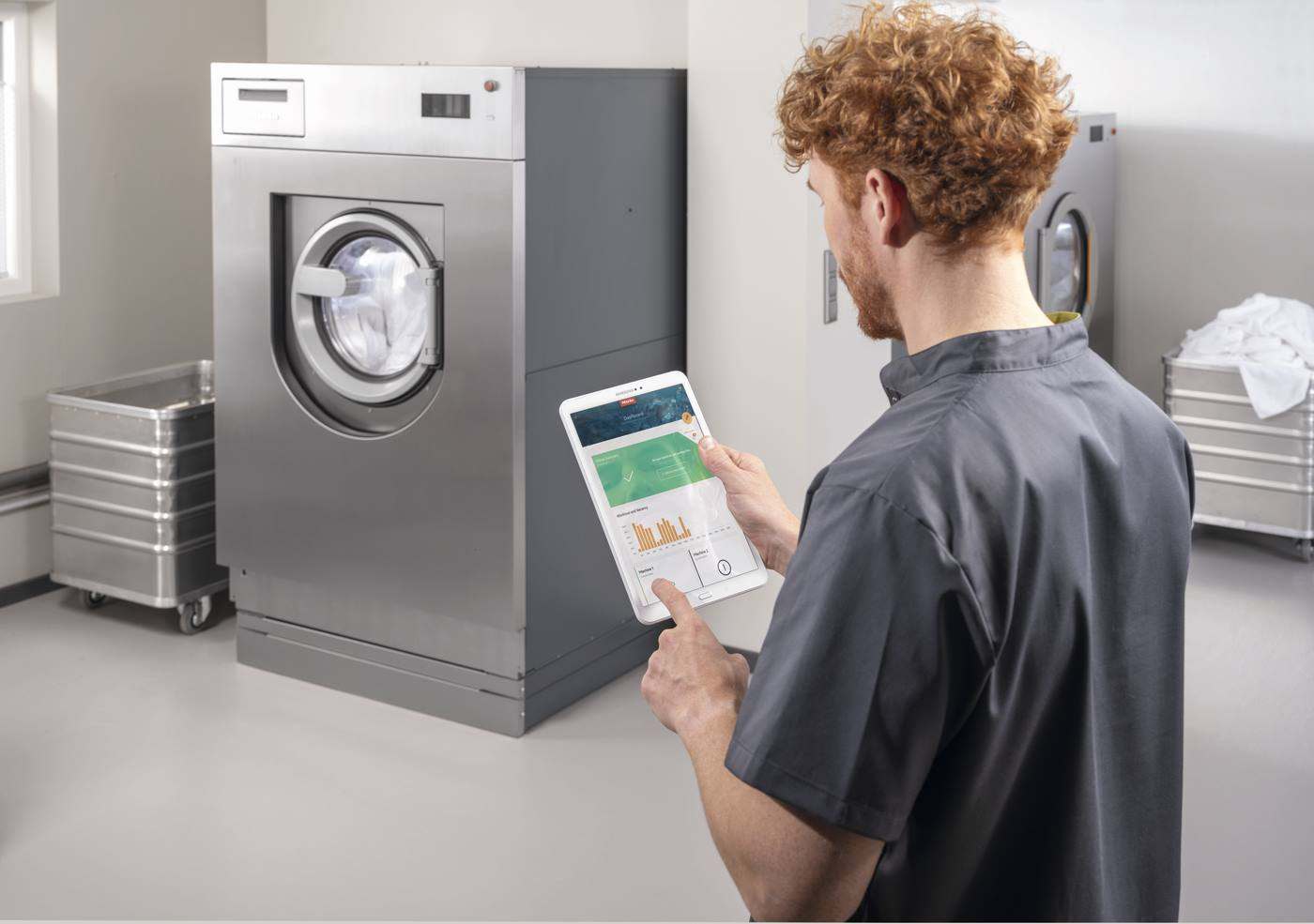
Perhaps the most under-discussed change is the role of connectivity. Machines are increasingly capable of providing operational data on usage, throughput and energy consumption, giving operators more visibility into how their laundries are performing.
In effect, laundry operations are becoming more visible and more measurable, which in turn makes them easier to optimise.
Where this leaves operators
None of these developments changes the fundamentals of running a laundry. Turnaround times, staffing pressures and consistent quality remain the priorities.
What is changing is the range of tools available to operators. Whether through more efficient equipment, better resource management or improved visibility of costs and performance, today’s laundries have more opportunities to improve how they work than ever before.
Not every business will adopt every innovation, but understanding where the industry is heading is becoming increasingly important.
For more information on how we can help you improve your laundry operation, call us today on: 0151 263 7451.