

A commercial dishwasher needs to do more than produce clean crockery. It must deliver consistent results throughout the working day, cope with the volume of items passing through the business and return them to service quickly.
That makes choosing the right machine an operational decision as much as a purchasing one.
Start with the volume of crockery
The right commercial dishwasher depends on the volume of crockery, glassware and cutlery to be processed, and how quickly it must be returned to use.
A small office kitchen, nursery or guesthouse will have different requirements from a busy restaurant or hotel. Some businesses need to process a relatively predictable number of items at set points during the day. Others need a continuous supply of clean crockery during concentrated service periods.
A dishwasher that is too small for the workload can create delays, leave staff waiting for clean items and encourage overloading. An unnecessarily large machine, meanwhile, may occupy more space and use more resources than the operation requires.
Before selecting a model, businesses should consider:
- how many loads are likely to be washed each day when the busiest periods occur
- how quickly items must be returned to service
- the type and size of the items being washed
- the amount of space available
- whether the machine will be used intermittently or continuously
Matching the machine to the actual workload is more useful than comparing capacity figures in isolation.
Consider cycle times in context
Cycle time needs to be considered alongside loading, unloading and drying. A rapid wash programme offers limited operational benefit if items still need to be dried by hand or left on racks before they can be used again.
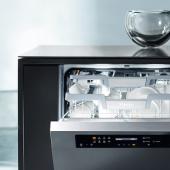
For example, the Miele PFD 100 SmartBiz is specified to wash 13 place settings in 36 minutes, with AutoOpen assisted drying at the end of the programme. It is designed for locations handling larger quantities of crockery, including offices, guesthouses, educational settings and small businesses.
Do not overlook drying performance
Drying is an important but sometimes overlooked part of the process.
If cups, plates or plastic items remain wet at the end of a programme, staff may need to dry them manually. That adds another task and can slow the return of clean items to service.
Plastic tableware can be particularly difficult to dry completely. In 2026, Miele Professional reported on laboratory testing carried out to establish whether reusable plastic cups could be cleaned hygienically and dried reliably in its commercial dishwashers. The testing included a specially designed basket and MasterLine fresh-water dishwashers equipped with the company’s Dry+ system.
For businesses regularly washing reusable cups, containers or other plastic items, drying
performance should be assessed alongside cleaning results.
Look at water and energy use per cycle
The purchase price is only one part of the cost of a commercial dishwasher. Water and energy are consumed every time the machine runs, so differences between models can accumulate over their working lives.
A machine that uses fewer resources per cycle may still be inefficient for a particular business if its capacity is too small and it must be run more frequently. Equally, selecting an oversized machine and routinely operating it with partial loads may undermine the anticipated savings.
A more meaningful comparison considers:
- water consumption per programme
- energy consumption
- load capacity
- typical daily cycle numbers
- detergent requirements
- drying performance
- expected maintenance and servicing
This creates a clearer picture of operating costs than the purchase price alone.
Check that the machine supports the required hygiene standards
Not every setting has the same hygiene requirements.
An office kitchen or small guesthouse may need a dependable machine for frequent everyday use. A nursery, school, care home or healthcare environment may require programmes, temperatures and processes suited to more demanding hygiene controls.
Miele says its fresh-water dishwashers change the water after each cycle before carrying out a final rinse at a temperature appropriate to the items being washed. The PFD 100 SmartBiz has a stated maximum final-rinse temperature of 82°C.
The specification should always be checked against the organisation’s actual requirements.
Make the machine easy to use correctly
Controls should be clear, programmes should be easy to select and baskets should suit the items being washed. Ease of use is particularly relevant where several people operate the machine, where staff turnover is frequent or where the dishwasher is only one of many responsibilities handled by the team.
Automatic detergent dosing, clear programme displays and well-designed baskets can help make the process more consistent.
Choose for the operation, not simply the specification
The right commercial dishwasher fits the available space and workload, produces the required standard consistently and integrates effectively into the organisation’s daily routine.
Wash performance remains fundamental, but it should be considered alongside capacity, turnaround time, drying, consumption, usability and support.
By examining those factors together, businesses can make a better-informed investment and choose equipment that supports the operation long after the initial purchase.
Talk to Liver Laundry Equipment
Liver Laundry Equipment can help businesses assess their warewashing requirements and identify commercial dishwashing equipment suited to their capacity, available space and operating environment.
Call us today on 0151 263 7451.